
Rigid Box Constructions Compared: Two-Piece, Magnetic, Drawer and Book-Style
Two-piece, magnetic, drawer or book-style rigid box? How each opens, the hand work, shipping and inserts, and what to settle before you ask for samples.
Buyers often start a rigid box enquiry with a photo of a box they like. That is a useful start, but the photo hides the decision that drives packing speed, freight and how the customer experiences the pack: the construction. Two boxes with the same paper, the same foil and the same outside size can behave very differently once one is a lid and base and the other is a drawer.
Below, each construction is covered in turn: how it opens, the hand work, shipping, inserts and fit, followed by a comparison table.
What are the main types of rigid box construction?
Every rigid box is greyboard (chipboard) that is cut, grooved, formed and wrapped in paper. What changes is how many parts there are and how they connect. Jinhao Xinyuan's rigid box page lists these constructions:
- Two-piece lid and base: a separate lid lifts off a base tray.
- Magnetic closure: an attached cover or flap closes onto the base and is held by magnets.
- Drawer (slide-out): an inner tray slides out of a printed outer sleeve.
- Book-style: a hinged cover opens along a spine like a hardback book, closed with magnets or a ribbon.
- Collapsible (flat-pack): a rigid box that ships flat and is folded into shape at the warehouse, with magnetic side panels holding it.
The company's pages give greyboard thicknesses from 1.5 mm for small jewelry and accessory boxes up to 3.0 mm for oversized retail boxes and hampers. Wraps run from art paper and kraft to textured specialty papers, soft-touch laminate and fabric veneers such as linen and velvet. The construction is a separate decision, and worth making first.
How does a two-piece lid and base rigid box work?
A two-piece box is two open trays: a base that holds the product and a lid that fits over it. The customer lifts the lid straight up. Lid depth is a design choice. A full-depth lid covers the base completely, a shallower lid leaves a band of the base showing, and a shoulder (or neck) version adds an inner collar so the lid sits on a step.
Hand work is the lowest of the rigid constructions, because both parts are built the same way: cut, groove, form the corners, wrap and turn in the paper. There is no hinge to align and no magnet to position. Jinhao Xinyuan describes the format as flexible in height, thickness and interior layout and simple to assemble, and its rigid box page lists reinforced greyboard walls of 2.0 to 3.0 mm, with rolled-edge or sharp-corner finishing.
A two-piece box ships at its finished size, so freight is paid on volume. Lid fit matters: too loose and the lid slides off in handling, too tight and trapped air slows the lift.
The open base takes almost any insert. The company lists foam and fabric inserts for its two-piece boxes, and a wrapped board insert or a paper tray can sit in the base as well. Jinhao Xinyuan positions two-piece as the default rigid box for premium retail: apparel, accessories, gift sets and corporate gifting. It fits products opened once or twice, where the presentation comes from paper and finishing.
How does a magnetic closure box open, and what does the magnet add?
In a magnetic closure box the lid is attached. A cover runs from the back of the base over the top, and its front flap closes onto the base, where magnets hold it shut. The customer lifts the flap and the box opens in one movement, then closes again with a click. Jinhao Xinyuan lists both a single magnetic flap and a dual-side closure, with hidden or visible magnets.
This is one of the more hand-intensive constructions. The base tray and the cover are built separately, magnets are set into the board at matching positions before wrapping, and the base is glued into the cover so the hinge lines up. Pull strength needs checking batch by batch: too weak and the flap lifts in transit, too strong and the box is hard to open. The company lists magnetic flap reinforcement among its options, and its Dongguan factory runs a semi-automatic assembly line for magnetic and collapsible rigid boxes.
The standard magnetic box ships assembled; a fully collapsible design is also offered. With the cover attached, there is no loose lid to separate in handling.
The company lists custom foam, EVA, cardboard and molded pulp inserts for magnetic boxes, plus reveal flaps, ribbon pull-tabs and inside printing for a brand message on the inner flap. It names cosmetics, fragrance sets, watches and electronics as typical uses. It suits products the customer will reopen many times; the company describes these boxes as sturdy enough to be reused.
When does a drawer (slide-out) rigid box make sense?
A drawer box is two parts: a printed outer sleeve, open at one or both ends, and an inner tray that slides through it. The customer pulls the tray out to reveal the product. Jinhao Xinyuan lists three pull options: a ribbon, a finger-cut, or a matched-paper tab.
Both parts are wrapped, and the slide fit between them is the critical tolerance. Too tight and the tray sticks or scuffs the wrap. Too loose and the tray slides out when the box is tilted. Judge the fit on a sample made with the final wrap, not a plain mock-up.
Drawer boxes ship assembled. Because the tray is held mainly by friction, a drawer box that travels alone through a parcel network usually needs something to keep the tray in place, such as a closure band, a wrap or a snug outer shipper.
The tray is a natural home for compartment inserts, which is why drawer boxes suit multi-piece sets. The company names chocolates, jewelry and pen sets on its rigid box page, and jewelry, accessories, electronics and high-value retail on its luxury gift box page.
What is a book-style rigid box, and how is it different from a magnetic box?
The terms overlap in the trade. On Jinhao Xinyuan's pages, a book-style box is a hinged-lid rigid box with a hardcover design that opens like a book, closed by magnets or a ribbon. In practice that means a case of front board, spine and back board wrapped as one piece, with the tray fixed inside. A magnetic box is defined by its magnet; a book-style box by its hinge and case.
Case-making adds steps. The boards are spaced to leave a hinge gap, the cover is wrapped across the spine, and the tray has to be glued square to the case so the cover closes flush. Hand work is comparable to a magnetic box and clearly more than a two-piece.
Book-style boxes ship assembled. The large flat cover gives a big printable surface, which the company highlights for branding and graphics. Because the cover opens fully, the whole insert is on view at once, which suits display-style sets. Jinhao Xinyuan lists premium photo albums, perfume sets and luxury sample kits, as well as electronics, cosmetics and premium gift sets.
Can a rigid box ship flat?
Standard rigid boxes cannot: they are glued into shape and travel at full volume. A collapsible rigid box ships flat and is folded into a finished rigid structure at the warehouse, where magnetic side panels lock it into shape. Jinhao Xinyuan lists magnetic, ribbon or Velcro closures for this construction and greyboard of 1000 to 1800 gsm.
The benefit is freight and storage volume: the company's pages quote shipping-volume reductions in the 60 to 80 percent range against pre-assembled rigid. Treat that as indicative and ask for a carton and pallet calculation on your own dimensions.
The trade-off is set-up time: someone has to fold each box before packing. For e-commerce gifting and export programs that is often worth it. Corner reinforcement is listed as an option for boxes meant for long-term use, and the company lists EVA, cardboard and foam inserts for its collapsible boxes.
How do the rigid box types compare side by side?
| Construction | How it opens | Hand work | Shipping and storage | Inserts | Typical fit |
|---|---|---|---|---|---|
| Two-piece lid and base | Lid lifts straight off the base | Lowest: two trays, no hinge or magnet | Ships assembled at full volume | Foam, fabric; trays or board inserts in the base | Retail gift sets, apparel, accessories, corporate gifting |
| Magnetic closure | Attached flap lifts and clicks shut | High: magnets set before wrapping, tray joined to cover | Ships assembled; collapsible version offered | Foam, EVA, cardboard, molded pulp; reveal flaps | Cosmetics, fragrance sets, watches, electronics |
| Drawer (slide-out) | Tray slides out of a sleeve | Medium to high: two wrapped parts, slide fit is critical | Ships assembled; tray needs securing for parcels | Compartment inserts in the tray | Chocolates, jewelry, pen sets, multi-piece sets |
| Book-style | Cover opens along a spine like a book | High: case-made cover, hinge, square tray fixing | Ships assembled; large printable cover | Display inserts seen all at once | Photo albums, perfume sets, luxury sample kits |
| Collapsible | Like a magnetic or ribbon box once set up | Factory build plus set-up at the warehouse | Ships and stores flat | EVA, cardboard, foam | E-commerce gifting, subscription, export programs |
Which inserts work with which rigid box construction?
- Two-piece: the open base takes the widest range, from foam and fabric-covered inserts to wrapped board and paper trays. Keep the product low enough for the lid to clear it.
- Magnetic closure: the insert must leave room for the flap to close flat. A reveal flap or a printed inner flap adds a second layer to the opening.
- Drawer: the insert lives in the tray. Allow for the slide, because an insert that stands above the tray wall will catch on the sleeve.
- Book-style: the whole insert is on view when the cover opens, so print and finish on the insert matter as much as on the outside.
- Collapsible: the insert usually goes in after set-up, so it should drop in without glue and help hold the walls square.
Jinhao Xinyuan also makes cardboard trays and inserts, folding cartons, labels and corrugated boxes, so a rigid gift box, its insert and its shipping carton can be quoted together.
What should you settle before asking for rigid box samples?
Most sample rounds that go wrong do so because the brief left one of these points open. Settle them first, roughly in this order.
- The construction and how the customer opens it. Name it (two-piece, magnetic, drawer, book-style or collapsible) and attach a photo or sketch of the opening.
- The internal dimensions, taken from the product and any insert, not the outside size of a box you like. Send a physical product sample if you can.
- The board and wrap: greyboard thickness, the wrap paper or fabric, and any lamination.
- The closing mechanism: lid fit, magnet position (hidden or visible) and how firmly it should hold, or the ribbon or pull you want.
- How often the box will be reopened, and whether customers are expected to keep and reuse it.
- How it ships: inside a retail master carton, alone in a parcel, or flat to a fulfilment centre.
- Finishes and target quantity, so the quote reflects a real run length.
Jinhao Xinyuan's quote request asks for box dimensions (L x W x H), material and finish requirements, design artwork if available, and target quantity. Its in-house design team assists with structural engineering and dieline creation, and the company offers samples and design mock-ups. Artwork is accepted as Adobe Illustrator (.AI), print-ready PDF at 300 DPI minimum, or CDR files.
Where does Jinhao Xinyuan make rigid boxes?
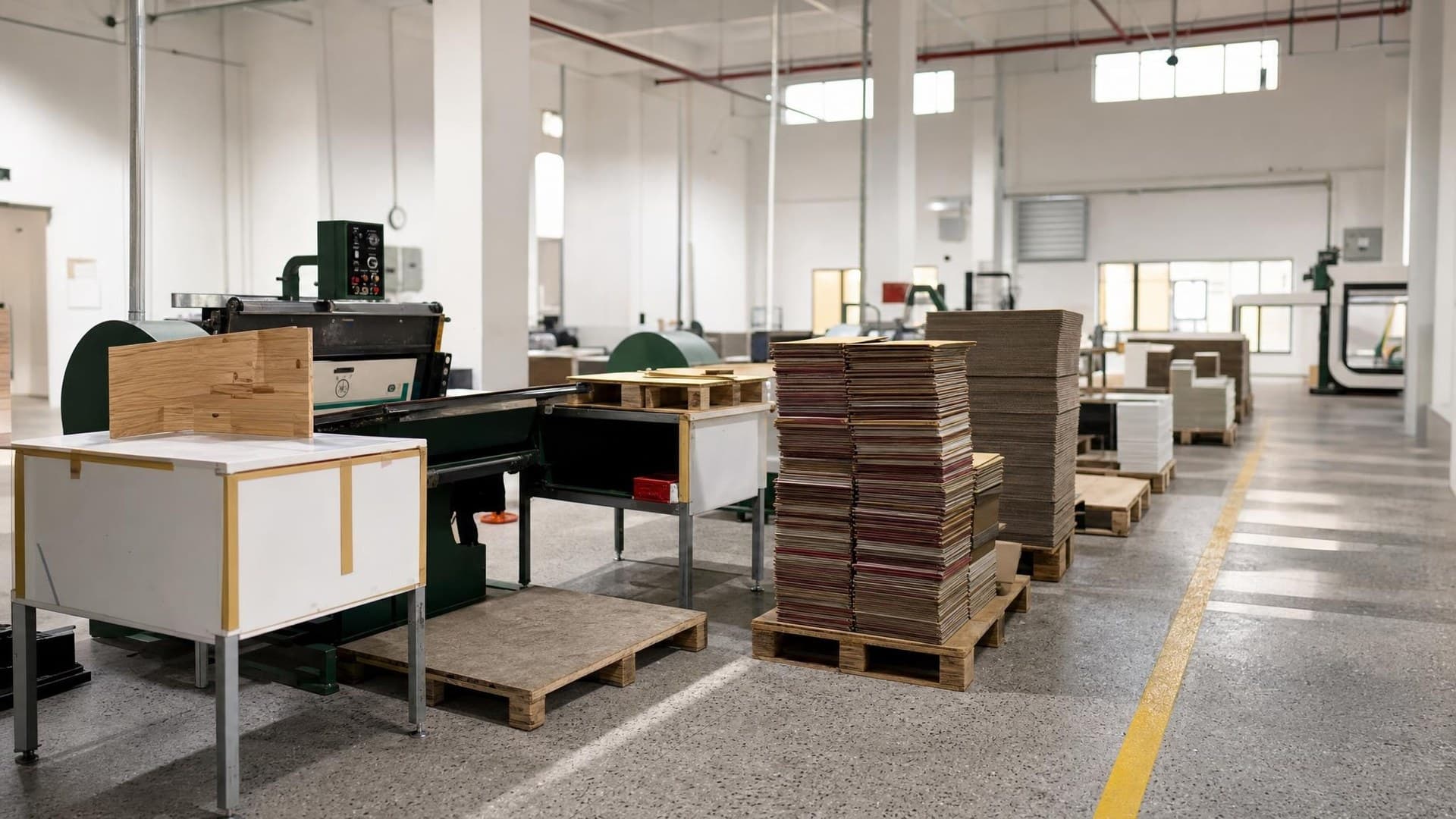
The company describes two production bases. In Changping, Dongguan, China, it combines automated precision grooving and die-cutting with skilled manual wrapping teams, running both side by side, from high-volume cartons to handmade gift boxes. The Dongguan factory page lists a semi-automatic rigid box assembly line for magnetic and collapsible boxes, alongside hot stamping and UV finishing systems.
In Bac Ninh Province, Vietnam, the company lists 8 dedicated lines and a rigid box workshop, with offset printing, corrugation and an on-site ISTA test laboratory.
The group lists FSC, ISO 9001 and SMETA certifications, with G7 and GMI color management. Scope differs by site, so ask for the certificates covering the factory making your job.
What should you ask about MOQ, lead time and documents?
This article does not quote minimum order quantities or lead times. Both depend on construction, size, finishing and season, so ask for them in writing against your specification:
- The MOQ for your construction and finish, and whether it differs between the Dongguan and Bac Ninh bases.
- Sample lead time, and what the sample includes: structure only, or printed and finished.
- Production lead time from sample approval, in writing, plus the port and the freight leg.
- The insert and the outer shipping carton on the same quote, if you need them.
- Which certificates cover the producing site, and whether the complete pack can be transit-tested.
Send us your product and the opening you want
Share the product size, the construction you have in mind, the board and wrap, and your target quantity. We will suggest a construction, prepare a structural drawing and sample, and confirm MOQ and lead time in writing for your specification.
Frequently asked questions
Which rigid box construction needs the least hand work?
The two-piece lid and base. Both parts are built the same way, with no hinge or magnet to align. Magnetic and book-style boxes need the most hand steps.
Is a magnetic box the same as a book-style box?
Not quite. A magnetic closure box is defined by the magnets that hold its attached flap shut. A book-style box is defined by its hardcover-style case that opens along a spine; its closure can be magnetic or a ribbon. Attach a photo or sketch to your enquiry so the quote matches the construction you mean.
Can a magnetic rigid box fold flat for shipping?
Yes, if it is designed that way. Jinhao Xinyuan lists magnetic boxes in fully collapsible or non-collapsible designs. The collapsible version ships flat and is set up at the warehouse, which saves freight and storage volume but adds a folding step before packing.
What greyboard thickness should a rigid box use?
It depends on size and product weight. Jinhao Xinyuan's pages give a range from 1.5 mm for small jewelry and accessory boxes to 3.0 mm for oversized retail boxes and hampers, and 2.0 to 3.0 mm walls for two-piece boxes. Heavier or fragile products need stronger board. Confirm the choice on a sample with the real product.
What is the MOQ and lead time for a custom rigid box?
Both depend on the construction, size, finishing and season, so ask for them in writing against your specification. Include sample and production lead time, and ask whether they differ between the Dongguan and Bac Ninh bases.