
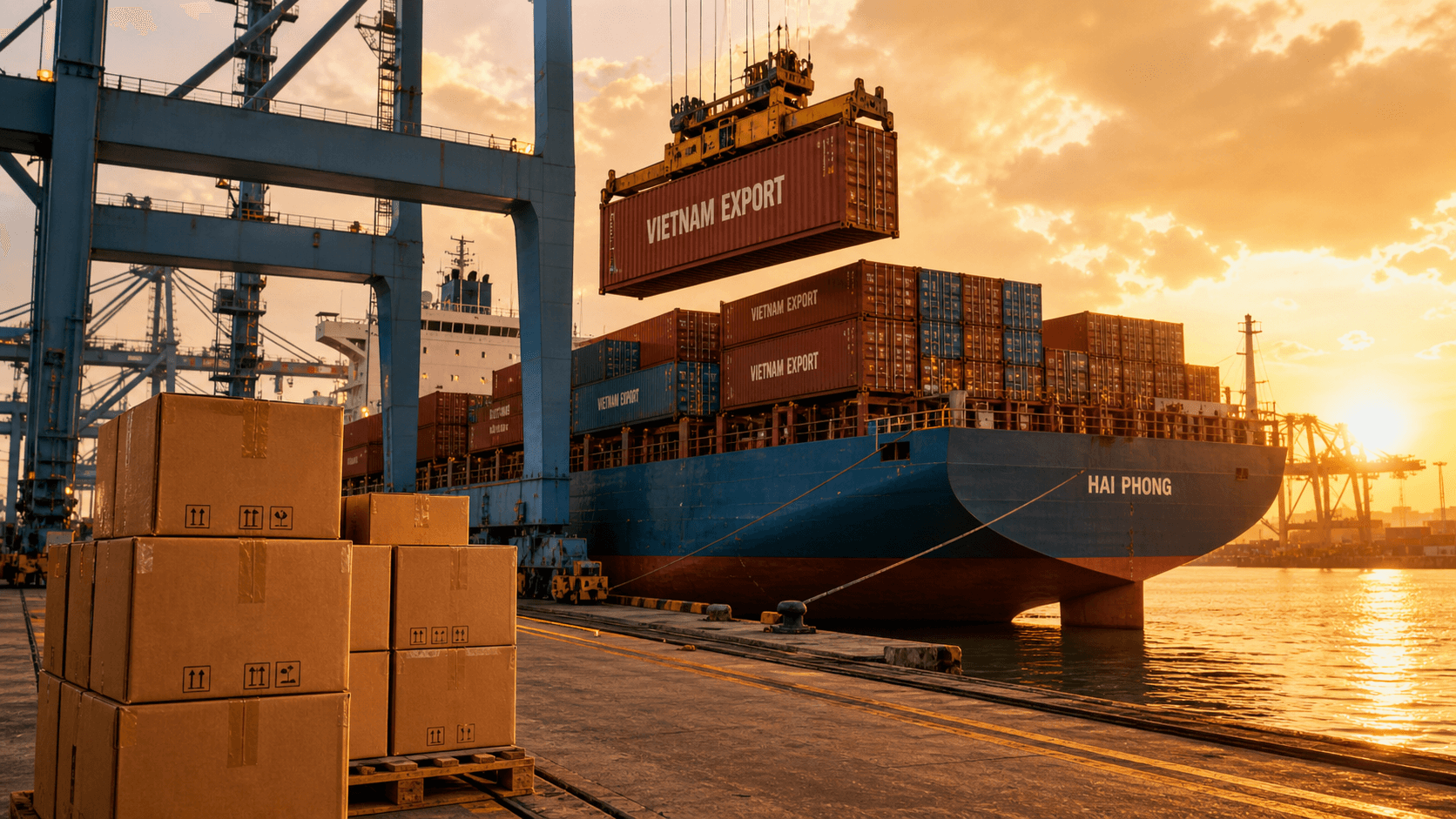
Vietnam Packaging Manufacturers: US Tariff-Free Guide (2026)
Are Vietnam packaging manufacturers tariff-free for US importers?
US Section 301 tariffs add 7.5–25% to packaging imported from China. Vietnam is exempt. For a buyer importing $500K of folding cartons annually, sourcing from a Vietnamese exporter with comparable certifications saves $25,000–$75,000 per year in landed cost — without compromising print quality, lead time, or compliance. Most Western buyers can switch suppliers in one production cycle.
This guide covers the actual tariff math, cert standards, MOQ/lead-time comparison, and a 10-point vetting checklist for first-time Vietnam buyers.
Why are US packaging buyers switching to Vietnam in 2026?
For most of the last two decades, “packaging supplier” and “China” were synonymous for Western brands. That equation has been shifting since the 2018 Section 301 tariffs first hit Chapter 48 paperboard and Chapter 39 plastic packaging categories — and the shift accelerated with the 2024 expansions and the broader US–China trade reset that followed.
Vietnam has emerged as the cleanest packaging-sourcing alternative. Not because Vietnamese factories are cheaper at the gate (they often aren't — labor and converted board can run 5–10% above comparable Guangdong pricing) but because the all-in landed cost, once tariffs and clearance fees are stacked, comes in 20–30% under the Chinese equivalent.
The companies switching aren't small. They're mid-market CPG brands, e-commerce 8-figure shops, cosmetics importers, and Fortune 1000 procurement teams that have been quietly running dual-source pilots for two or three years and are now consolidating volume to Vietnamese suppliers. The decision is rarely about ideology — it's a spreadsheet exercise.
This guide walks through the actual math, the certification standards Western buyers verify, the MOQ and lead-time tradeoffs, and a vetting checklist drawn from the questions our procurement customers ask before placing first orders.
The tariff math: what US importers actually save
Section 301 duties stack on top of the standard Most-Favored-Nation (MFN) rate that all imports pay. For paperboard packaging (HTS 4819), the structure looks like this:
| Cost component | From China | From Vietnam |
|---|---|---|
| Factory price (FOB) | $1.00 | $1.05 |
| MFN duty (HTS 4819.10) | $0.00 (free) | $0.00 (free) |
| Section 301 List 3 | +$0.25 (25%) | Not applicable |
| Sea freight + clearance | $0.08 | $0.10 |
| Landed cost per unit | $1.33 | $1.15 |
| Saving per unit | $0.18 (13.5%) |
Illustrative only. Actual savings depend on HTS classification, specific 301 list applicability, and the FOB delta at your volume. Run the math against your own 12-month buy.
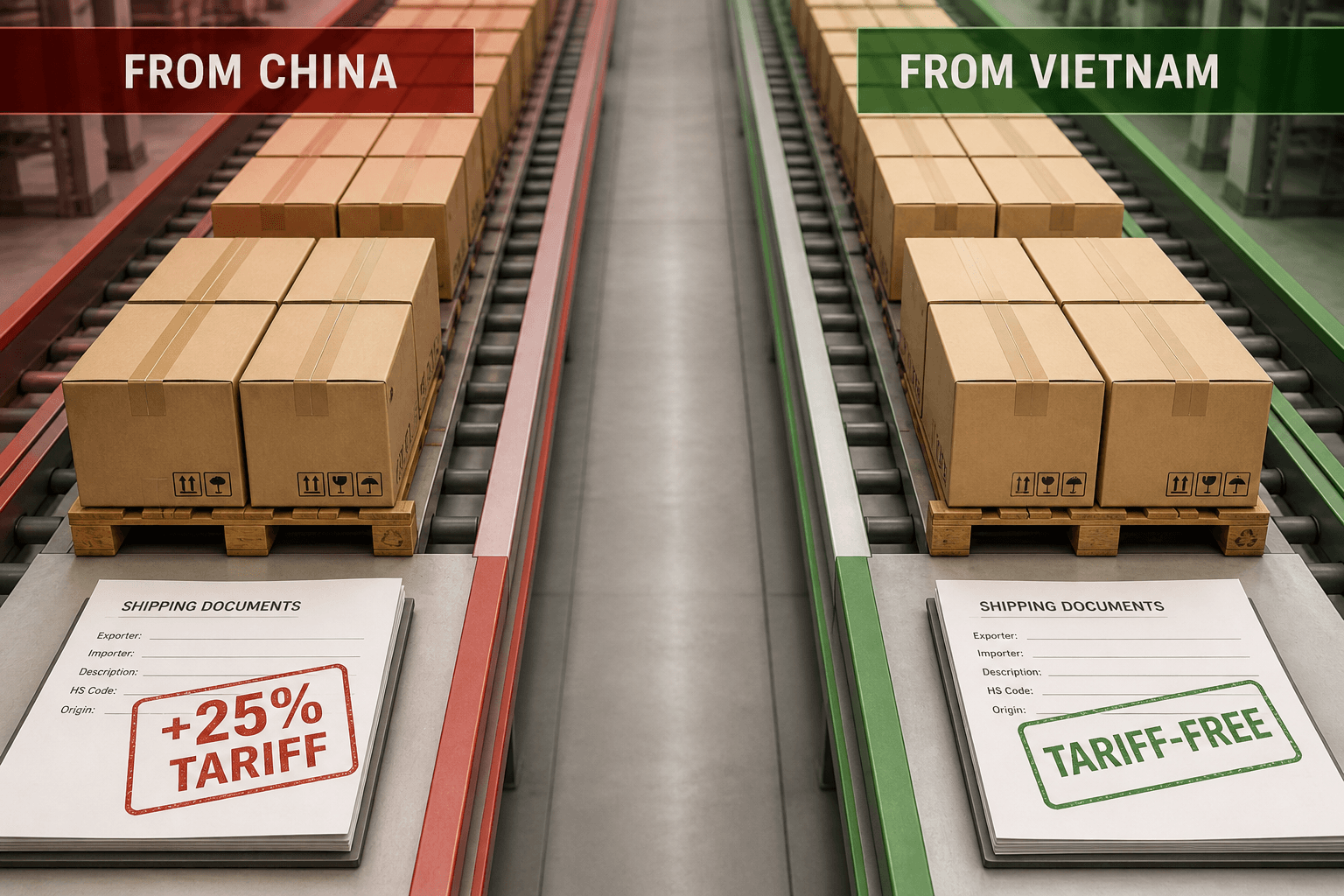
For Chapter 39 plastics (PE/PP mailers, blister packs, plastic gift boxes), the savings are even more pronounced — Section 301 hits most of those at 25%, and Vietnam's MFN rate matches China at 5.3% (no 301 surcharge). Net delta typically lands at 18–22%.
The math shifts the moment your annual packaging spend crosses ~$200K. Below that, the supplier-switch friction (re-doing dielines, color matching, sample iteration) often eats the savings in year one. Above $500K, a year-one ROI of 4–8x on the switching cost is normal.
Lead times, MOQ, and capacity: practical comparison
Production lead time
25–45 days
vs 18–35 days from China. Specialty paper imports add the gap.
Sea freight to USWC
18–22 days
Hai Phong / HCM City to LA / Long Beach. Comparable to North China ports.
Typical MOQ
3K–10K units
For offset folding cartons. 1K–5K for rigid boxes. 500–2K for corrugated mailers.
The capacity story is more nuanced than a single “Vietnam slower” or “China faster” line. For standard kraft and white-back paperboard, the largest Vietnamese exporters operate Heidelberg XL and Komori Lithrone presses sized identically to comparable Guangdong plants — same 200 million-card monthly throughput, same automated folding-gluing lines.
Where Vietnam runs slightly behind is in specialty board sourcing. High-grade SBS, certain FBB grades, and recycled-content luxury boards are still partially imported from China, Indonesia, and Korea — adding 5–10 days of material lead time. For brands using stock kraft or bleached white paperboard (the majority of corrugated mailers, e-commerce shippers, and standard FCG packaging), this gap is invisible.
For premium rigid boxes and luxury folding cartons with embossing, hot-foil, and specialty coatings — Vietnam has caught up substantially since 2022, but the highest-end specialty work (deep cold-foil, lenticular, certain holographic effects) still has more depth in Guangdong and Shanghai. For 90% of B2B packaging specifications, the Vietnamese output is indistinguishable from a comparable Chinese facility.
Certifications: what US buyers actually verify
Procurement teams at every Western buyer of any size run the same cert checklist. If a Vietnamese supplier can't produce these on first request, they're not a serious candidate.
FSC Chain-of-Custody
Required by Walmart, Target, IKEA, and most EU retailers. Verify the FSC license number on info.fsc.org — about 40% of Vietnamese packaging exporters hold valid FSC CoC.
ISO 9001:2015
Quality management system. The certification body should be IAF-recognized (TÜV, BV, SGS, BSI). Ask for the certificate body and the registration number — verify on the body's public registry.
SMETA / Sedex
Social audit covering labor, health & safety, environment, and business ethics. Required by ethical-sourcing buyers like Unilever, P&G, Tesco. Ask for the Sedex Member Number and the most recent audit's CAPR.
G7 / GMI
Color-management certification. G7 Master Qualification is rarer in Vietnam than in China but increasing. GMI compliance is the more common practical standard for retail-print color consistency.
Beyond these, food-contact and cosmetic packaging adds ISO 22000 or BRC, and electronics packaging often requires ISTA 3A or 6-Amazon.com-SIOC test reports. None of these are unique to Vietnam — they're the same standards a Chinese supplier needs to ship to a Western buyer.
One specific tip from procurement teams: validate certificates on the issuing body's public registry, not just the PDF the factory sends. A surprising percentage of forwarded certs in this industry are out of date or scoped to a different facility within the same group.
Where to source: Vietnam's three packaging hubs
Packaging production in Vietnam clusters around three regions, each with a different specialty and freight profile.
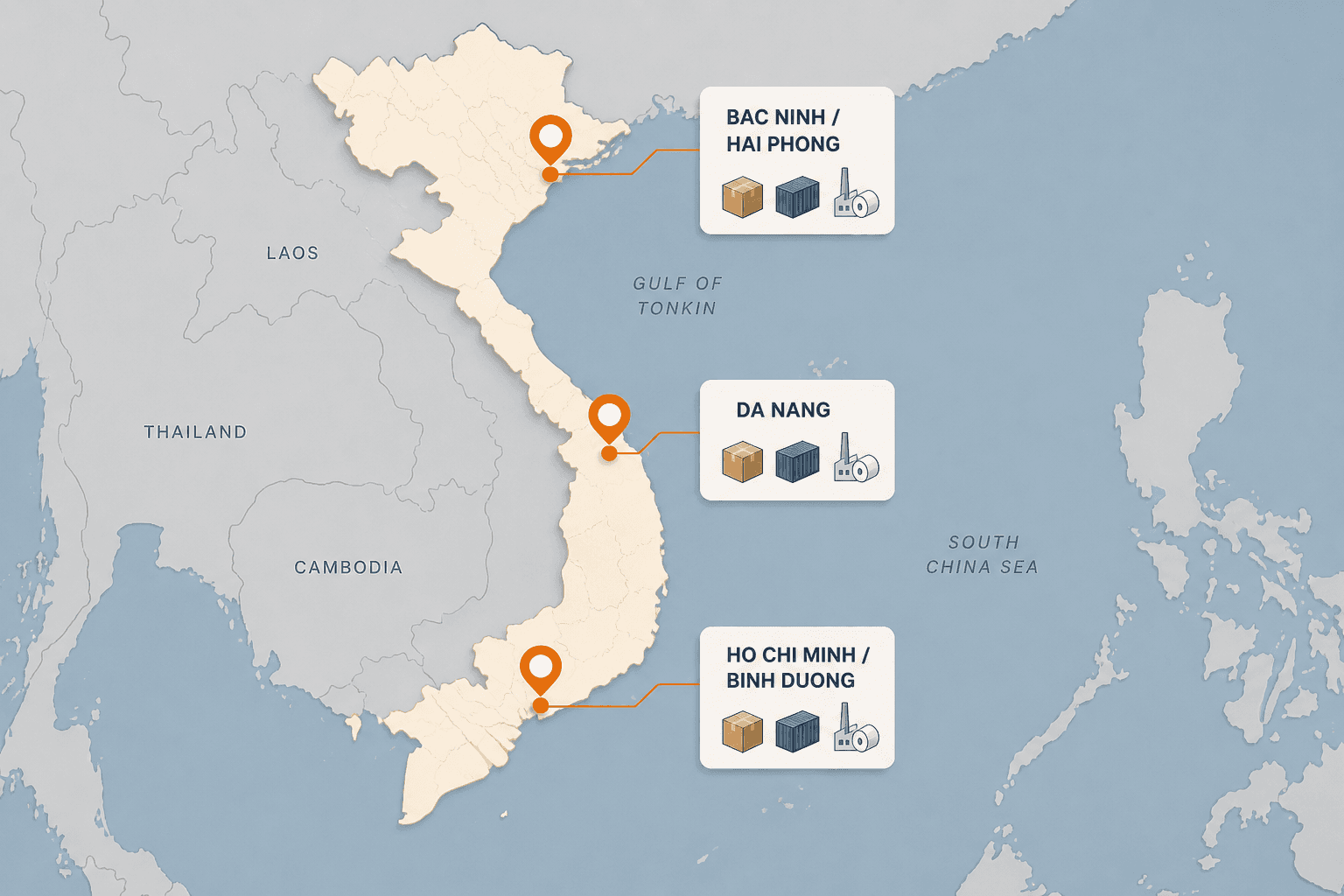
- 1
Northern Vietnam — Bac Ninh, Bac Giang, Hai Phong
The largest concentration of FSC-certified paperboard and rigid-box exporters. Hai Phong port handles most US- and EU-bound packaging shipments. Capacity here grew 60%+ between 2020 and 2025 as Chinese-owned and Vietnamese factories both expanded. This is where our Bac Ninh facility operates.
- 2
Southern Vietnam — Ho Chi Minh, Binh Duong, Long An
Strongest in food-grade and cosmetic packaging. Cat Lai and Cai Mep ports serve US East Coast and Southeast Asia. Lower labor costs than the north but slightly tighter capacity for premium offset work.
- 3
Central Vietnam — Da Nang, Quang Nam
Smaller but growing. Specialty in corrugated for furniture and electronics export. Often used as a secondary fulfillment hub for buyers who want geographic redundancy across multiple Vietnamese provinces.
10-point vetting checklist for first-time Vietnam buyers
Before you place a sample order, validate these. Every legitimate Vietnamese packaging exporter should answer all ten in writing within 48 hours.
- 1FSC Chain-of-Custody license number — verify on info.fsc.org
- 2ISO 9001:2015 certificate — request the certificate body and registration number
- 3SMETA audit report — ask for the most recent CAPR (Corrective Action Plan Report)
- 4ISTA-certified test lab on-site (compression, vibration, drop tests)
- 5G7-certified color management OR documented GMI/Pantone process
- 6Production capacity statement (m²/month) and current capacity utilization
- 7Reference customers in your industry (request 2–3 with permission to contact)
- 8Sample policy — does first sample cost get credited against production order?
- 9Incoterms options (EXW, FOB, CIF, DDP) and which they regularly use
- 10Compliance pack: packaging-specific REACH, prop 65, FDA food-contact (if applicable)
Frequently asked questions
Are packaging imports from Vietnam subject to US Section 301 tariffs?
No. Section 301 tariffs (typically 7.5–25% on covered HTS codes) apply to goods of Chinese origin under HTS Chapter 48 (paper/paperboard) and Chapter 39 (plastic packaging). Goods substantially transformed and originating in Vietnam fall outside Section 301 entirely. They still incur the standard MFN duty (often 0–5% for paperboard packaging), so the all-in landed cost typically drops 20–30% versus comparable Chinese sourcing.
What's the typical lead time difference between Vietnam and China packaging?
For corrugated and folding cartons, sample-to-shipment is 25–45 days from a Vietnam factory vs 18–35 days from a comparable mainland China facility. The difference comes down to material lead times (some specialty papers are imported into Vietnam from China or Indonesia). For standard kraft and white-back paperboard, Vietnamese factories are now within 3–5 days of Chinese turnaround. Sea freight from Hai Phong / Ho Chi Minh to US West Coast averages 18–22 days versus 14–18 from Shanghai/Ningbo.
What certifications should US buyers verify before placing a Vietnam packaging order?
At minimum: FSC Chain-of-Custody (paper traceability), ISO 9001:2015 (quality management), and SMETA (social/ethical compliance). For food-contact and cosmetic packaging add ISO 22000 or BRC. For G7-certified color reproduction at retail-print quality, look for facilities with G7 Master Qualification — this is rarer in Vietnam than in China but increasing. Always request the certification numbers and validate them on the issuing body's public registry.
What's the minimum order quantity (MOQ) at most Vietnam packaging factories?
Standard MOQs run 3,000–10,000 units for offset-printed folding cartons, 1,000–5,000 for rigid gift boxes, and 500–2,000 for corrugated mailers. Lower MOQs (500–1,000) are usually possible for digital-printed runs at a 10–15% per-unit premium. Compare this to China where MOQs of 1,000–3,000 are typical for similar SKU complexity.
Is the print quality from Vietnam packaging factories comparable to China?
For mid-tier and premium offset printing, yes — most established Vietnamese exporters run Heidelberg, Komori, or KBA presses identical to Chinese facilities. The gap shows up in the highest-end specialty finishes: cold-foil, lenticular, certain spot UV effects. Vietnam has fewer factories at the very top of the print-tech curve, but for 90% of B2B packaging needs, the output is indistinguishable.
Can a Vietnam factory accept artwork files and procurement processes set up for a Chinese supplier?
Yes. Most established Vietnamese exporters use the same Adobe-based prepress workflow (Illustrator, InDesign), accept the same color profiles (G7, GMI, FOGRA), and follow the same QC standards (ISTA, ISO). Switching from a Chinese supplier to a Vietnamese one is largely a logistics and contract change, not a workflow rewrite. Most factories will accept dielines and color-matched proofs from your existing Chinese supplier as a starting point.
Working with Jinhao Xinyuan: dual-hub Vietnam + China
We operate two integrated facilities — a 30,000 m² FSC- and ISO-certified plant in Bac Ninh, Vietnam, and a 13,900 m² premium color-box plant in Dongguan, China. Most of our US, UK, and AU shipments now route through Bac Ninh for the tariff reasons covered in this guide. Buyers needing top-end specialty finishing on a specific SKU can split production: bulk volume from Vietnam, the specialty run from Dongguan, both consolidated to one shipment.
What we ship: corrugated export cartons, e-commerce mailer boxes, shelf-ready packaging, retail folding cartons, luxury rigid gift boxes, magnetic-closure boxes, jewelry and cosmetic packaging, and adhesive labels. FSC, ISO 9001:2015, SMETA, and G7-certified.
Run the tariff math against your own packaging spend
Send us your current dielines, volume, and supplier quotes. We'll return a Vietnam-source quote and a side-by-side landed cost comparison within 1 business day.
Request a Tariff-Free QuotePublished May 4, 2026. Tariff math is illustrative; specific HTS classifications and 301 list applicability change. Always confirm with your customs broker for your specific SKU and shipment.