
Rigid Gift Box Buyer's Guide: Magnetic, Lift-Off, Drawer
How to choose between magnetic-closure, lift-off, and drawer-style rigid gift boxes for retail — construction, cost, finishing, and best fit by SKU.
How do you choose the right rigid gift box — magnetic, lift-off, or drawer?
Rigid (or "set-up") boxes are constructed by wrapping printed paper around a chipboard substrate that's typically 1.5–3.0 mm thick. Unlike folding cartons (which ship flat and are erected at the fill line), rigid boxes ship pre-assembled. They're heavier, more expensive to freight, and command 3–5× the unit cost of an equivalent folding carton — which is why they're reserved for products where presentation is part of the value proposition.
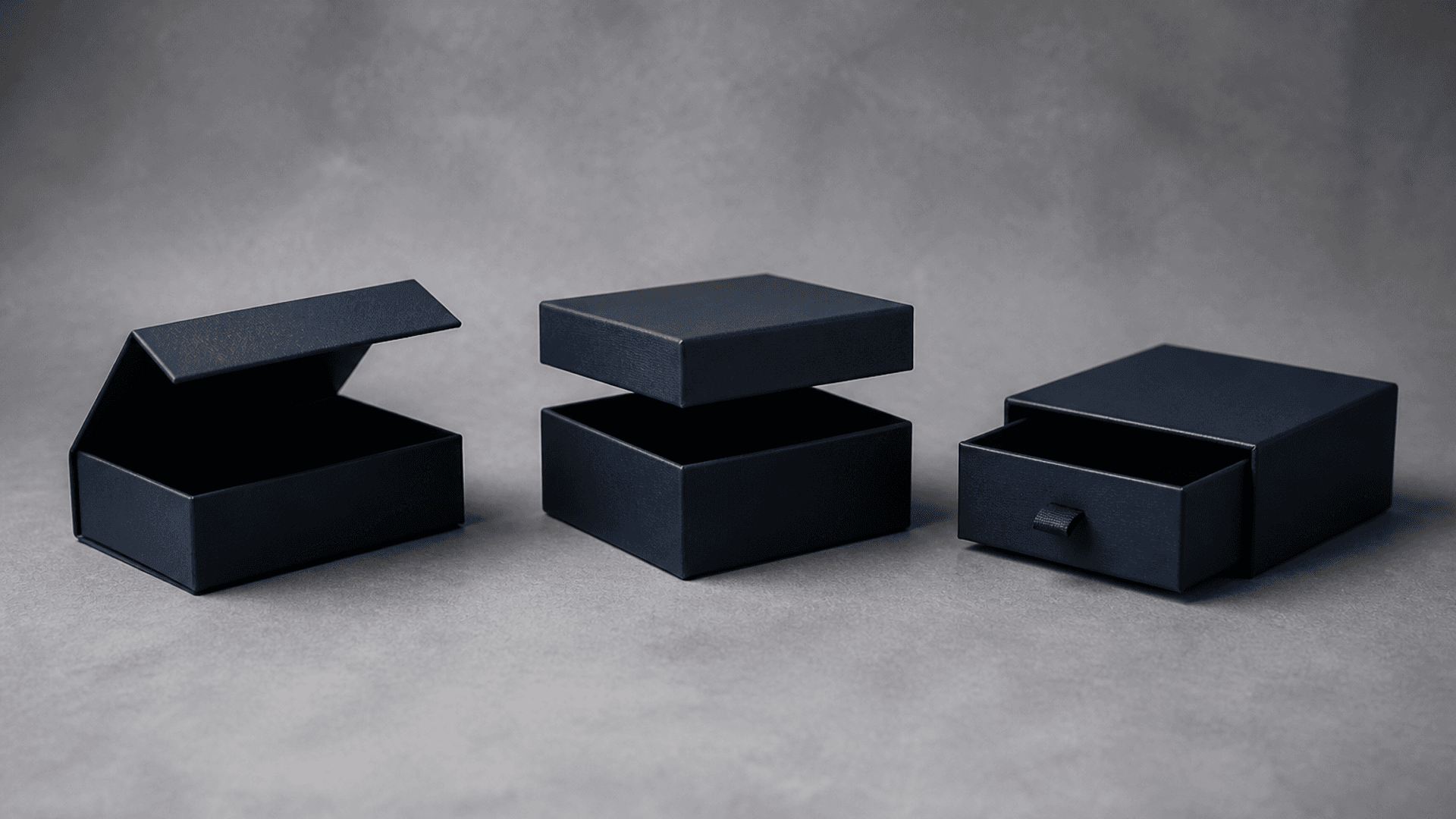
Three structural styles dominate the rigid market: magnetic-closure (book-style hinge with embedded magnets), lift-off lid (telescoping two-piece, also called shoulder boxes), and drawer (an inner tray that slides out of a sleeve). Within each style there are dozens of variations, but most procurement decisions come down to picking among these three.
Magnetic-closure boxes: the unboxing moment
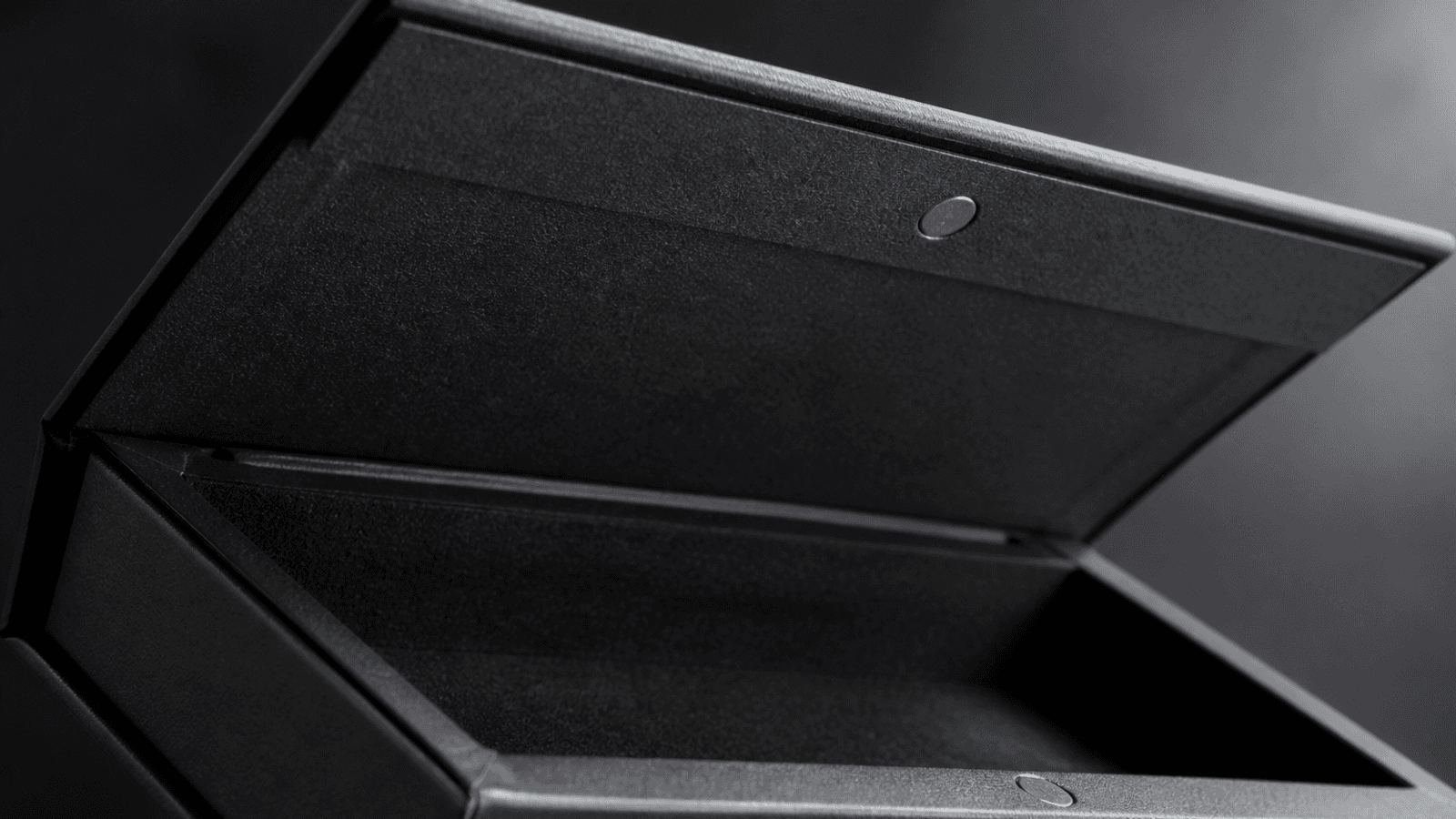
Magnetic-closure boxes are constructed as a single hinged piece — flap, spine, base — with disc magnets embedded in matching positions on the flap and base. The hinge is a creased substrate (the part of the chipboard that bends), wrapped continuously by the cover paper. Done well, the box opens and closes in a satisfying mechanical motion that defines the unboxing experience for the brand.
Cost: highest of the three styles. Expect 25–40% premium over a lift-off box of the same size and finishing. Magnet cost itself is small ($0.05–$0.15 per pair); the premium comes from labor — magnetic boxes require more hand-assembly steps and tighter QC.
When magnetic wins: premium consumer launches (electronics, beauty, jewelry, spirits), subscription-box hero pieces, brand collaborations, anything where the unboxing moment is itself the marketing. When magnetic loses: fragile or oddly shaped contents that need a deeper inner tray (drawer is better), high-volume programs where the cost premium outweighs the experience uplift, and any product category where the customer doesn't open the box ceremonially.
Lift-off lid (telescoping) boxes: the workhorse
Lift-off boxes are a two-piece construction: a base tray and a lid that fits over the top with a small overlap (the "shoulder"). They're the most common rigid format globally because they're the cheapest to produce, the fastest to assemble, and the most forgiving on tolerances.
The lid-to-base fit is a structural variable: a tight fit (5–8 mm shoulder, snug clearance) feels premium but slows assembly; a loose fit speeds production but feels cheap. Mid-range factories typically tune this for a specific drop test result and brand feel rather than producing one-size-fits-all.
Cost: baseline reference. Lift-off is the format other styles get priced against.
When lift-off wins: high-volume retail packaging where quality matters but cost matters more, gift sets and assortments where you just need a clean container, products with simple symmetric shapes. When lift-off loses: anything where the unboxing experience is part of the brand promise (use magnetic) or where you need a sliding reveal (use drawer).
Drawer-style boxes: the reveal
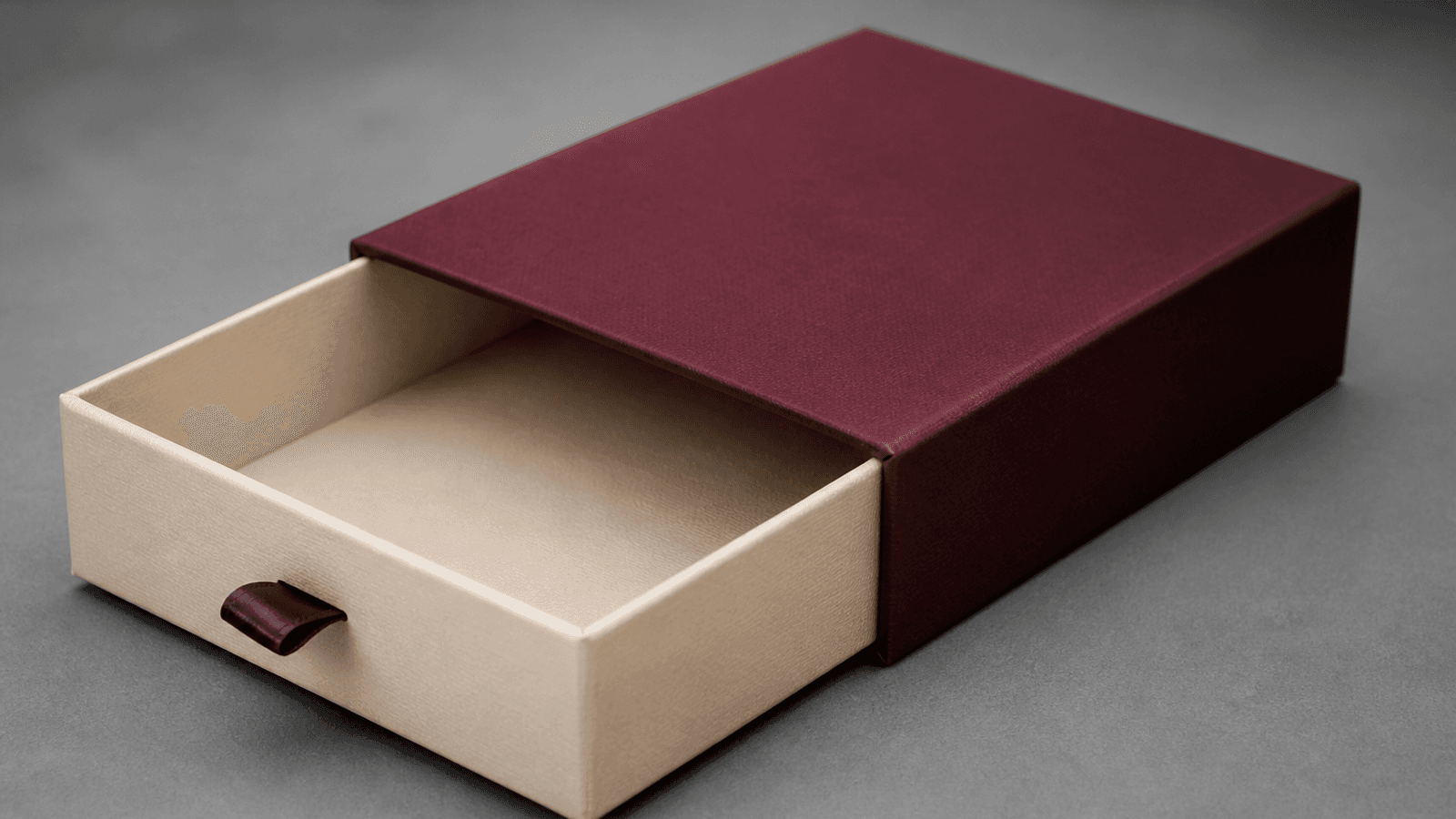
Drawer boxes (also called "slide boxes" or "matchbox-style") are built as two pieces: an outer sleeve (open on one or both ends) and an inner drawer that slides through. The drawer typically has a pull tab — sometimes a satin ribbon, sometimes a small finger notch. The reveal motion makes drawer boxes the natural choice for multi-piece sets, fragrance gift sets, premium jewelry, and Asian gift conventions where a sliding presentation has cultural resonance.
Cost: 15–30% premium over lift-off, slightly less than magnetic. Drawer construction requires extra cutting and gluing operations on both the sleeve and the drawer, plus the slide fit needs careful tolerance — too tight and the drawer jams, too loose and contents shift in transit.
When drawer wins: multi-piece sets (jewelry, fragrance, pen sets), products where the sliding reveal is part of the experience, Asian gift conventions, anything with an inner tray that needs a stable horizontal position. When drawer loses: standalone single products (lift-off is cleaner), anything that gets dropped in transit (drawer slides are the most failure-prone of the three), and tight retail-shelf footprints where the sleeve overhang adds dimensional waste.
Side-by-side comparison
| Attribute | Magnetic | Lift-off | Drawer |
|---|---|---|---|
| Unit cost vs lift-off | +25–40% | baseline | +15–30% |
| Production speed | slowest | fastest | slow |
| Premium feel | highest | medium | high |
| Drop-test resilience | high | high | lower |
| Best for | single hero product | high-volume sets | multi-piece reveals |
| Typical MOQ (Vietnam) | 1,000–3,000 | 500–2,000 | 1,000–3,000 |
| Lead time | 30–45 days | 20–30 days | 30–40 days |
Finishing decisions that move cost more than closure choice
The closure debate is well-known. What gets less attention is that finishing choices often dominate the per-unit cost much more than which closure you picked.
- Cover paper: art paper (cheap), specialty textured paper (mid), fabric or leatherette (premium). Specialty paper alone can add 30–50% to the box cost.
- Hot foil stamping: $0.08–$0.25 per unit depending on coverage. Cold foil is cheaper but visibly less crisp.
- Spot UV / matte vs gloss: a few cents to ~$0.10 per unit, but the visual impact is dramatic.
- Embossing / debossing: $0.05–$0.20 per unit, depending on die complexity.
- Inner tray: foam (cheap, generic), molded paperboard (mid, eco-positive), velvet-lined thermoformed (premium). Trays add as much to cost as the box itself for high-end products.
- Magnet count and size (magnetic only): two 8mm discs is standard; four magnets or a 12mm pair adds cost and pull strength but tightens unboxing motion.
Sourcing decisions: Vietnam vs China for rigid
Rigid box production has historically been concentrated in coastal China — particularly Dongguan and Shenzhen — and Vietnamese capacity has been thinner than for folding cartons. That has changed quickly since 2022. As of 2026, multiple Vietnamese factories run identical equipment (Pemco, Sysco, Bobst rigid lines) to their Chinese counterparts and produce at comparable quality.
The remaining gap: highest-end specialty finishes (lenticular, holographic foil, specialty fabric wrapping) are still more available from Chinese suppliers. For 90% of retail rigid programs, Vietnamese factories meet or exceed Chinese output. For the top 10% — luxury launches with bespoke finishing — staying in China still makes sense, although tariffs add 25% to that program's landed cost.
Vietnam vs China for packaging — the full picture
Tariff math, lead-time comparison, and a 10-point vetting checklist for first-time Vietnam buyers. Read the cornerstone guide.
Frequently asked questions
What's the typical MOQ difference between magnetic, lift-off, and drawer in Vietnam?
Lift-off has the lowest MOQ — most Vietnamese factories will run 500 units for offset-printed lift-off boxes. Magnetic and drawer typically start at 1,000–3,000 units because the additional assembly steps make sub-1,000 runs uneconomic. For digital-printed runs (no plate cost), some factories will go as low as 250–500 units across all three styles, at a 15–25% per-unit premium.
Which closure is most likely to fail in transit?
Drawer is statistically the worst performer in standard ISTA-3A drop testing — the inner tray can shift, jam, or come fully out of the sleeve. Lift-off and magnetic both perform well when the shoulder fit (lift-off) or magnet strength (magnetic) is tuned. For shipping-heavy programs (e-commerce, subscription), magnetic with strong pull is the most resilient of the three. For retail-only programs that ship pre-packed in master cartons, the difference is academic.
Can I mix closure styles within one product line?
Yes, and it's common — luxury beauty brands often use magnetic for hero product launches and lift-off for seasonal limited editions or refills. The brand consistency comes from shared paper, color palette, and printed branding, not from identical structure. Two warnings: (1) maintain a consistent finishing standard or the cheaper boxes look obviously cheap next to the magnetic ones, (2) document the closure choice in your packaging spec template so artwork doesn't get sent to the wrong dieline.
What's the cost of switching from lift-off to magnetic mid-program?
Tooling cost is small ($300–$800 for new dieline, magnet placement, possibly new paper grade), but the bigger costs are sample rounds and the disposal of any printed lift-off lid stock you've already produced. Plan a 6–8 week transition with one sample round and a small validation PO before full cutover. Don't switch closure styles in the middle of a peak season — do it during a slow quarter.