
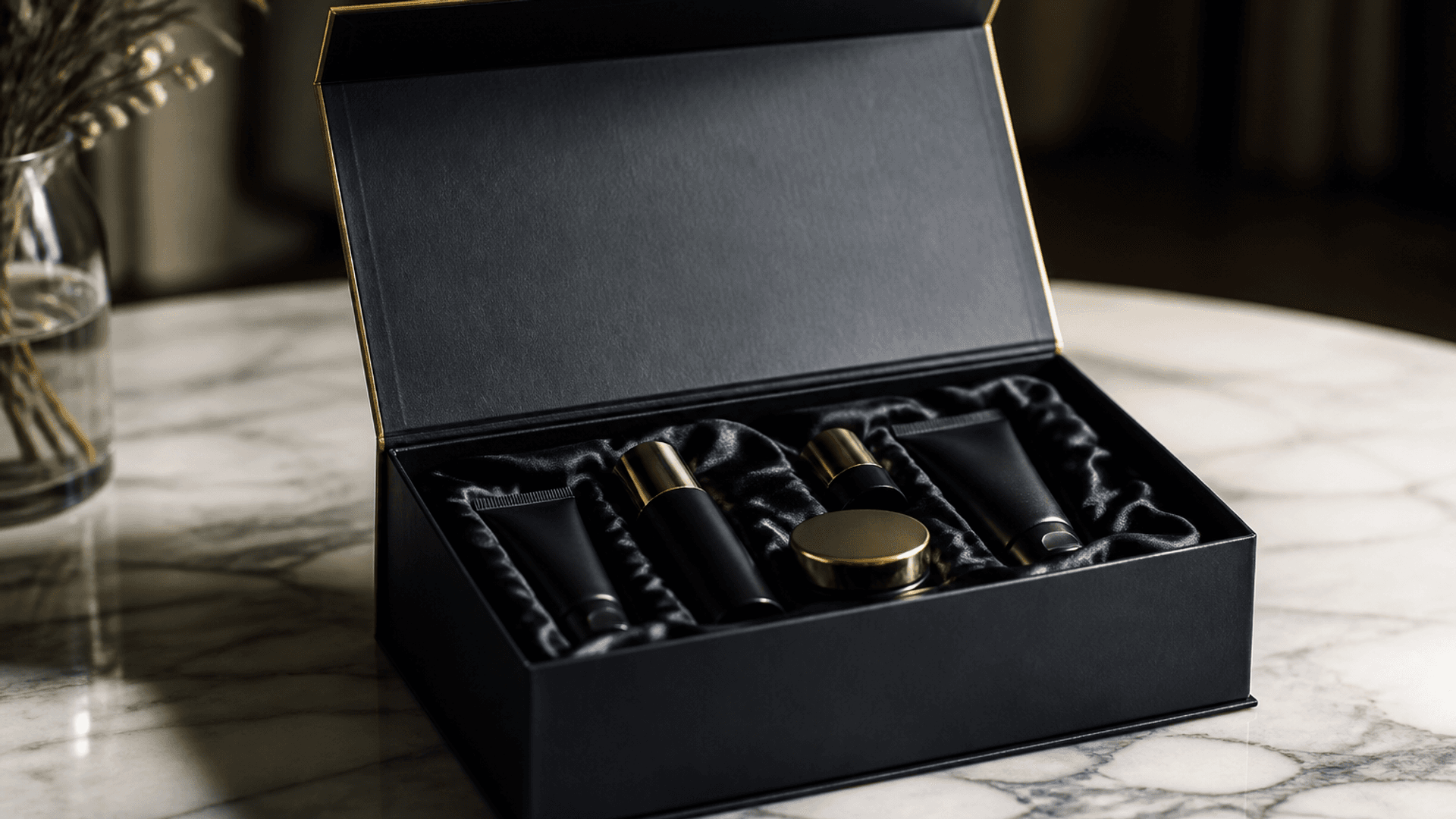
Cosmetic Gift Box Sourcing Guide: MOQs, Lead Times, and the 5 Mistakes Suppliers See Most
What beauty brand procurement teams need to know about cosmetic gift box sourcing — realistic MOQs by closure type, lead-time math for holiday launches, finishing decisions that matter, and the most common briefing failures suppliers see.
How do you source custom cosmetic gift boxes from Vietnam?
Beauty brand procurement teams often treat gift boxes as "just rigid box sourcing" — pick a supplier, send the artwork, get the boxes. The reality is more constrained. Cosmetic gift boxes have to function on three axes simultaneously: as retail packaging that survives shelf rotation and merchandising, as e-commerce shipping packaging that survives a parcel network, and as a brand presentation moment that holds up to social-media unboxing. Trade-offs between these three drive most of the sourcing complexity.
Add the holiday-driven calendar — Q4 launches concentrate volume into a 6-week production window — and the typical timeline pressure. Most cosmetic gift box failures aren't quality failures; they're calendar failures.
MOQ realities by closure type
| Closure | Vietnam offset MOQ | Vietnam digital MOQ | Per-unit cost vs lift-off | Lead time |
|---|---|---|---|---|
| Magnetic | 1,000 | 300–500 | +30–40% | 30–45 days |
| Lift-off | 500 | 200–300 | baseline | 20–30 days |
| Drawer | 1,000–1,500 | 300–500 | +15–25% | 30–40 days |
| Book-style with foam well | 1,500 | 500 | +40–50% | 35–45 days |

The realistic Q4 holiday calendar
If your gift box needs to be on shelf November 1, working backwards through the supply chain:
- Late October: in retailer DC and being merchandised
- Mid-October: at US port, customs cleared, in inland trucking to retailer DC (allow 7–10 days)
- Late September: on water, trans-Pacific from Vietnam (18–22 days)
- Mid-September: completed production, at Hai Phong port awaiting load (2–3 days)
- Late August: production starts in Vietnam (20–30 days for offset, longer if foiled and finished)
- Mid-August: PO confirmed, paperboard ordered, plates produced (5–7 days)
- Early August: artwork final, color-matched proof signed off
- Late July: spec brief locked, sample approved
- Early July: first sample round complete
- Mid-June: spec brief delivered, samples ordered
- Mid-May: supplier shortlist confirmed, finalist selected
Counted forward from supplier selection: 5–6 months of total calendar to land on shelf November 1. Most cosmetic teams that miss holiday do so because they started in mid-August expecting 6 weeks and discovered they needed 16. The 5–6 month rule is the mid-tier supplier reality. Top-tier suppliers with reserved capacity for major brand customers can do it faster, but only if you have the relationship pre-established — not as a first-time buyer.
The 5 mistakes that delay cosmetic gift box programs
1. Late spec changes after sample approval
The single most common cause of delay. Sample approved in week 4, then in week 7 marketing decides the brand color shifted slightly, the foil should be rose gold instead of gold, or the box should be 2 mm taller to accommodate a SKU change. Each post-approval change costs 2–4 weeks. Lock the spec at sample sign-off, and require any changes after that point to come with a calendar impact estimate from procurement before the spec change is approved.
2. Weak Pantone briefs
"Make it our brand orange" is not a brief. Pantone PMS numbers, with secondary references for printed swatches and digital pixel values, are the brief. Cosmetic brands often have signature colors that drift from Pantone numbers over years; if the agency-provided brand-book number doesn't match what the brand currently uses, you'll get the agency-provided color back from the converter. Always cross-check the latest produced packaging with the brief Pantone before locking it.
3. Foil coverage that breaks the recyclability rating
Hot foil stamping at small accent coverage (logo, brand name) doesn't materially affect recyclability. Hot foil at 30%+ surface coverage (large decorative areas, foiled sleeves, or full-pattern foiling) starts to interfere with paperboard pulping and can downgrade the EU PPWR recyclability rating from B to D. For brands selling into EU markets, this matters. Decision rule: if foil coverage is over ~15% of the box surface, request a recyclability assessment alongside the sample.
4. MOQ misjudgment
Brands often order to a forecast that turns out optimistic. The result: 5,000 units of holiday gift box in the warehouse on January 5, with no second life — gift boxes are seasonally specific and can't be repurposed. Two fixes: (1) order to a conservative central forecast and accept slightly higher per-unit cost from the smaller run; (2) split production across two POs, with the second one dependent on early sell-through data. Most converters will accommodate split POs at a 5–10% premium and it usually pays for itself in lower obsolescence.
5. Starting the conversation 6 weeks before holiday
We get inbound inquiries every September from brands hoping to launch a Black Friday gift set. The honest answer at that point is "not for this year" — even with rush production, expedited freight, and air shipping (which adds $20–$40 per kg, transforming the unit economics), the supply chain doesn't compress that much. Brands that consistently hit holiday do so because they start sourcing in May or June for November shelf. Treat any sub-12-week request with skepticism.
Materials decisions for premium feel
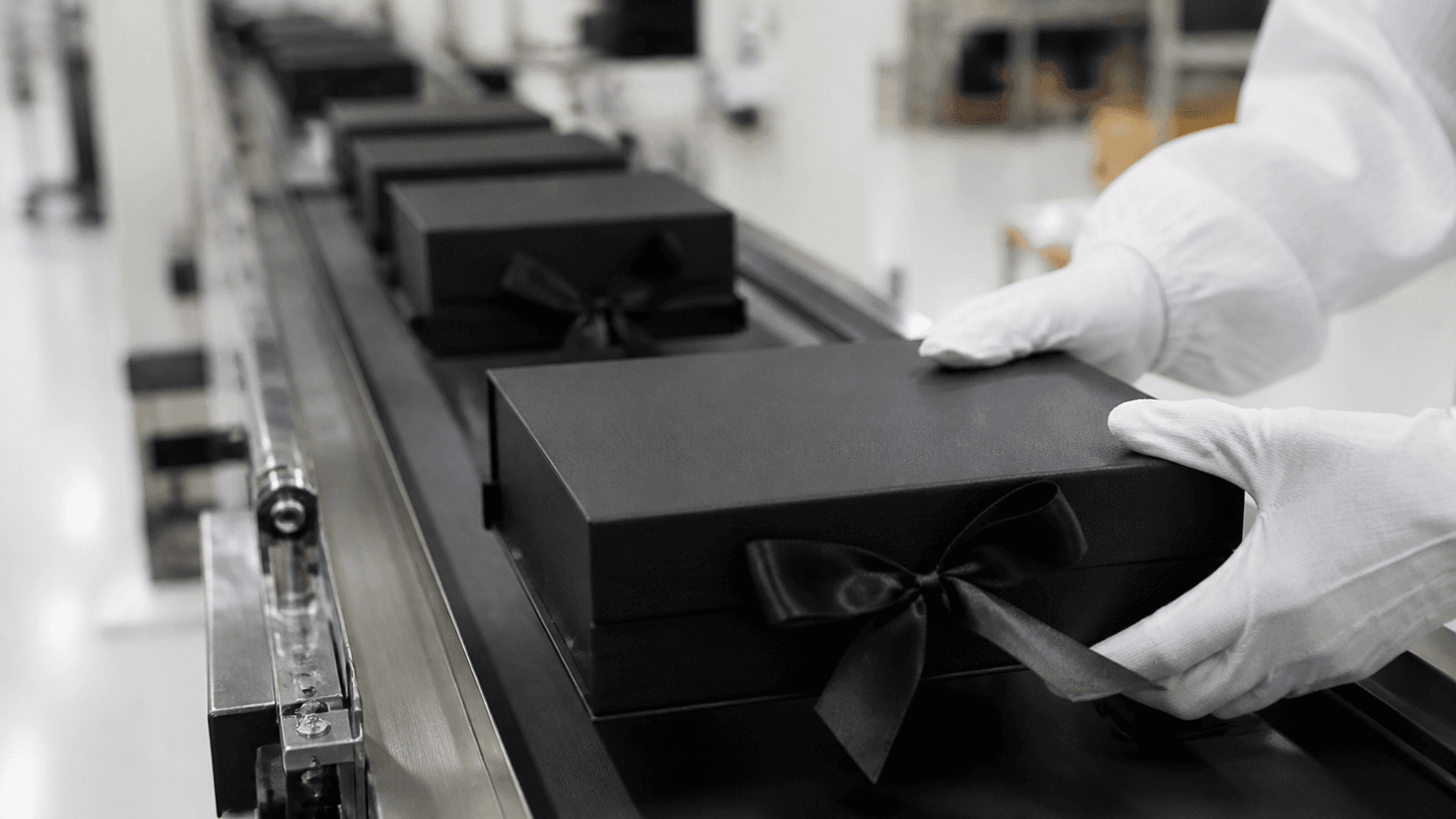
- Cover paper — specialty textured paper (Wibalin, Buckram, or a fashion-grade equivalent) significantly outperforms standard art paper for premium feel. Cost premium ~25–40% on a per-box basis. Worth it for hero programs.
- Inner tray — molded paperboard pulp tray (eco-positive, mid-cost) vs thermoformed plastic with velvet flocking (premium, plastic). For PPWR-compliant programs, paperboard pulp wins; for ultra-premium, flocked plastic still has a tactile edge.
- Lining — printed paper lining is standard; satin or grosgrain ribbon and cloth lining add ~$0.30–$0.80 per box. The unboxing moment differential is significant.
- Edge finishing — gilded edges (gold or silver foil applied to the edge of the lid) are a $0.40–$0.80 premium and a strong premium signal.
- Magnet pull (magnetic closure only) — 12mm dual disc magnets give a satisfying "click" close. 8mm singles save $0.10 but lose the audible feedback that customers associate with quality.
Sustainability messaging that holds up
Beauty brands face increasing scrutiny on packaging sustainability claims. Three claims that are defensible and procurement-actionable:
- FSC Mix — Chain-of-Custody verified paper traceability. Use the FSC mark only when you have a job-specific FSC invoice from the converter, not just a Lobby-wall display.
- Recycled content — most paperboard for gift boxes uses 30–70% recycled fiber. Specify a minimum percentage and require it on the supplier declaration.
- Plastic-free — increasingly demanded for cosmetic gift sets. Achievable with paperboard pulp inner trays, paper lining, and water-based dispersion coatings instead of plastic windows or PE laminations.
Avoid: vague "eco-friendly" claims without substantiation, recycled-content claims that don't match the actual converter declaration, and "recyclable" claims on packaging that won't pulp cleanly due to heavy foiling or laminations.
Closure choice: magnetic vs lift-off vs drawer
The structural debate that drives most cosmetic gift box procurement decisions. Read the full closure comparison.
Frequently asked questions
What's a typical cosmetic gift box per-unit cost from a Vietnamese factory?
Wide range based on closure, finishing, and volume. A simple lift-off cosmetic gift box at 5,000 units with offset CMYK printing and matte lamination runs $1.80–$2.80 per unit. A magnetic-closure box with foil stamping, premium textured paper, and a paperboard pulp inner tray at 3,000 units runs $4.50–$7.00. A bespoke drawer box with multiple foil colors, gilded edges, and velvet-flocked tray at 2,000 units runs $8.00–$14.00. Compare to a Chinese supplier at the same spec — Vietnam typically lands 18–25% lower all-in landed cost.
Can I order cosmetic gift boxes for delivery to multiple country markets in one PO?
Yes, and it's common. Best practice: produce a single base SKU with English (or your global language) primary copy, and apply country-specific overlays — translated regulatory copy, local brand names, sticker labels — at the destination DC rather than at production. This avoids the alternative (running multiple SKU variants, each with its own MOQ) which inflates total cost. The downside is sticker labels look cheap on premium boxes; for ultra-premium programs, multi-SKU production is unavoidable.
How do I handle the spec brief for a co-branded or limited-edition gift box?
Lock both brand teams to a single spec doc before sending to the supplier. Co-branded programs fail more often than single-brand programs, almost always because the two brand teams are sending revisions to the supplier separately and the converter is implementing whichever one is most recent. Run all changes through one procurement-side gatekeeper, even if both brands have to compromise on internal review timelines.
What's the smallest cosmetic gift box program that's economically viable from Vietnam?
Around 1,000 units for offset-printed lift-off cosmetic boxes, or 300–500 units if you can use digital printing. Below that, freight and customs overhead per unit get prohibitive — for a single 500-unit program, ocean freight alone is $4–$5 per box. For test launches under 500 units, consider domestic US digital print or short-run domestic boxes; the per-unit cost is higher but you avoid the freight overhead and 60+ day lead time.
Keep reading
- Rigid gift box buyer's guide
- Vietnam packaging — full buyer's guide
- Cosmetic gift boxes — capabilities
- Luxury rigid gift boxes
- Rigid box manufacturing in Vietnam
- Folding cartons manufacturer Vietnam
- Custom Printed Gift Boxes
- Inside Jinhao Xinyuan's Dongguan Factory: How a Premium Printed Carton Is Printed, Coated, Cut and Folded