
Folding Carton vs Rigid Box: How to Choose on Cost, Freight and the Unbox
Folding carton or rigid box? How each is made, why rigid costs more, what flat shipping saves, which products suit each, and where collapsible rigid boxes fit.
Buyers often arrive at this question from the wrong end: a mood board, a foil logo and a soft-touch finish first, and only later the discovery that the structure underneath decides the unit price, the freight bill and how fast the packing line runs. Folding cartons and rigid boxes are not two price points of one product. They are two manufacturing routes with different tooling, materials and cost curves.
Jinhao Xinyuan Group makes both, in Bac Ninh, Vietnam, and at Dongguan Xinyuan Printing in Guangdong, so this guide is written from the factory side. Figures quoted are the ones the company publishes on its product pages; where it publishes none, this article says so.
What is the difference between a folding carton and a rigid box?
A folding carton is cut from a single sheet of cartonboard. The sheet is printed, coated or laminated, die-cut into a flat blank with crease lines, and then folded and glued along one seam. It leaves the factory flat, stacked in shipping cartons, and is squared up and closed at the point of filling, either by hand or on an automatic cartoning line. Tuck-end, seal-end, auto-lock bottom and hanger cartons are all folding cartons.
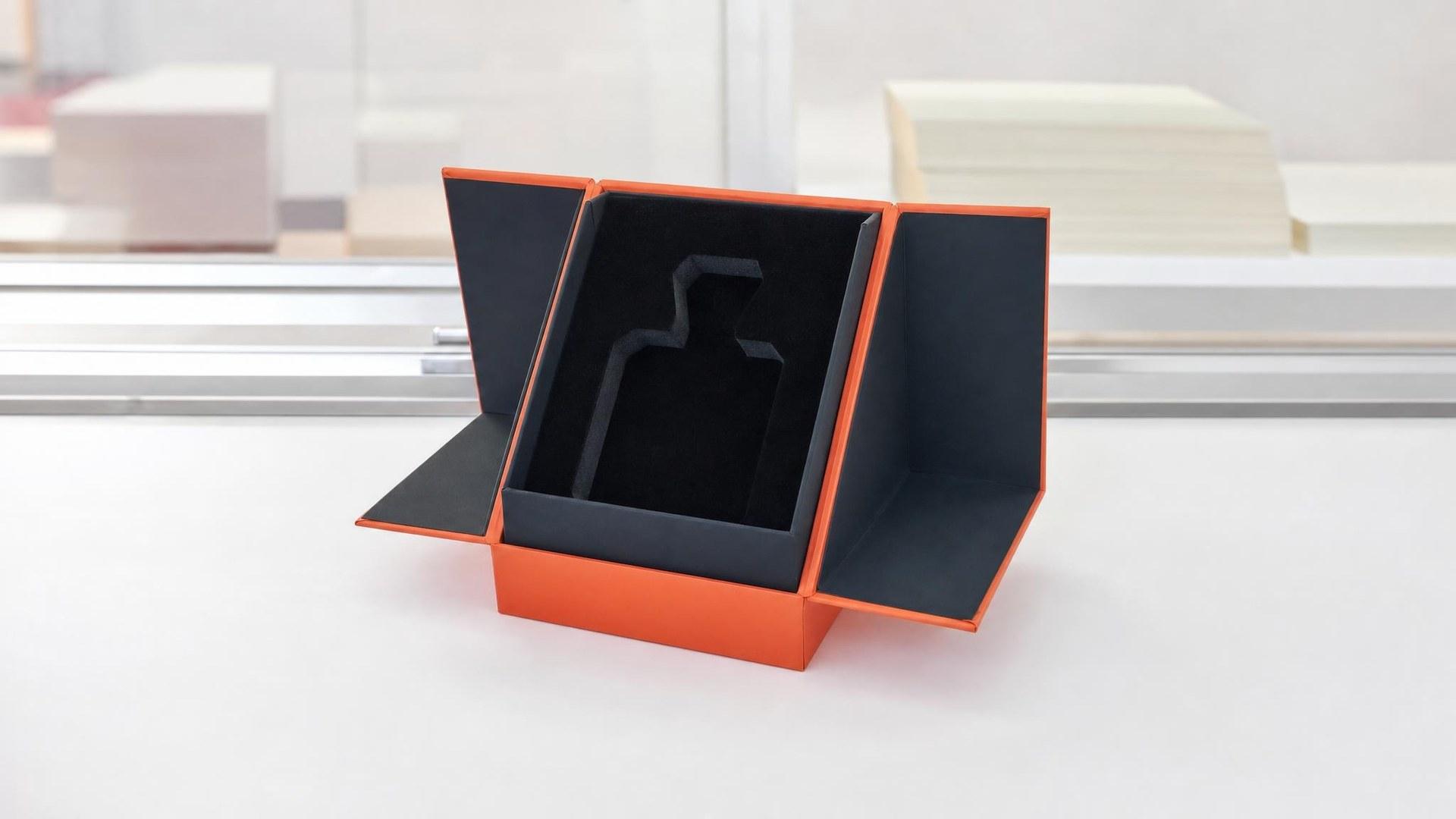
A rigid box is built rather than folded. A thick greyboard (chipboard) core is cut and formed into a base and a lid, a drawer and sleeve, or a hinged book shape, and the outside is wrapped in a separately printed paper, specialty paper or fabric. The finished box is assembled at the factory and keeps its shape whether or not anything is inside. Two-piece lid-and-base, magnetic-closure, drawer and book-style boxes are all rigid boxes.
- Material: a folding carton uses paperboard; Jinhao Xinyuan lists paperboard from 250 to 450 gsm for printed gift cartons. A rigid box uses greyboard measured in millimetres; the company's rigid box page lists 1.5 mm for small jewellery and accessory boxes up to 3.0 mm for oversized retail boxes and hampers.
- Print surface: a folding carton is printed directly on the board. A rigid box is printed on a wrap sheet that is then laminated around the board, which opens up specialty papers, kraft, textured stock and fabric veneers such as linen or velvet.
- Shipping state: the folding carton ships flat; the rigid box ships at full volume, unless it is a collapsible design.
- Who finishes the box: the folding carton is completed by whoever fills it; the rigid box is completed at the factory.
Why does a rigid box cost more than a folding carton?
The gap is structural, not a markup. A folding carton runs through print, finishing, die-cutting and folder-gluing as one flat sheet. Once the die is made and the press is set, each additional sheet adds paperboard, ink and machine time, and the blank comes off the folder-gluer ready to pack. At Dongguan, for example, cartons move from Heidelberg CX102 and XL105 six-color presses with inline coating to Bobst and MK automatic die-cutters and then to Vega and Jagenberg high-speed folder-gluers. Every step is a high-speed sheet or blank operation.
A rigid box adds a second material and a second set of operations. The greyboard has to be cut and formed into trays, the wrap has to be printed and finished as its own job, and the wrap then has to be glued, laid and turned in around the board so the corners are tight and the edges sit square. Magnets, ribbons, drawers and hinges add parts and steps. Jinhao Xinyuan runs semi-automatic rigid box assembly for magnetic and collapsible boxes in Dongguan, and its pages describe dedicated rigid box lines at both Bac Ninh and Dongguan. Even with that equipment, a rigid box carries more material and more handling per unit than a folding carton of the same footprint.
- More material per box: a millimetre-scale greyboard core plus a wrap sheet, against a single sheet of board.
- More operations: board cutting, tray forming, wrap printing, wrapping and assembly, against print, cut and glue.
- More parts: magnets, ribbons, inserts and closures are common on rigid boxes and rare on folding cartons.
How do freight and storage change the comparison?
For an exporter, the line on the quote is only part of the cost. A folding carton occupies almost no space until it is erected: thousands of flat blanks fit in the space of a few hundred finished boxes. A pre-assembled rigid box occupies its full outer volume from the factory floor to the packing table, so pallet counts, container space, inbound freight and warehouse racking all scale with the size of the empty box.
On a short domestic lane that difference may be modest. On a sea lane from Hai Phong or the Pearl River Delta to Europe or North America, and then through a fulfilment centre that charges for storage, it can be larger than the difference in unit price. That is why the decision should be made on a landed basis, not on the factory quote alone: unit price, plus freight per unit, plus storage per unit for the weeks the stock sits before it is packed.
- Ask each supplier for units per outer carton and per pallet, for both structures.
- Convert that into units per container for your lane, then into freight cost per unit, and add storage per unit.
- Only then compare totals; a cheaper unit price can lose once the box is moving air across an ocean.
Which products belong in a folding carton, and which in a rigid box?
The cleanest test is to ask what the box has to do after it is opened. If the customer throws it away, the box only needs to protect, inform and sell on the shelf. If the customer keeps it, displays it or gives it as a gift, the box is part of the product and the extra cost of a rigid structure buys something the customer can see and touch.
Usually a folding carton
- Cosmetics and skincare at retail volume, where the carton sits on a shelf and is discarded at home.
- Food, confectionery and FMCG, including coated cartons for dry, chilled or frozen goods, which Jinhao Xinyuan lists among its folding carton applications.
- Electronics accessories and small devices that need a precise fit and a clean print, but not a keepsake box.
- Pharmacy, supplements and anything that runs on an automatic cartoning line, where a flat blank that erects in a fraction of a second is the whole point.
- E-commerce products that need a light, flat-packed retail box inside a corrugated shipper.
Usually a rigid box
- Jewellery, watches and pens, where the box is opened more than once and often kept.
- Fragrance and premium cosmetic sets, where weight, a magnetic close and an insert holding several items matter.
- Flagship electronics, where the unboxing is part of the launch and the box has to hold its shape around a heavy item.
- Corporate gifts, PR kits and seasonal gift sets, where the presentation is the reason for the purchase.
- Photo albums, sample kits and book-style presentation packs that need a hinged cover.
Often a collapsible rigid box
- Subscription and e-commerce gifting programs that want a rigid unbox but ship and store large quantities.
- Influencer and PR boxes that are packed in batches at a fulfilment centre rather than at the factory.
- Export programs where inbound freight volume, not unit price, is the cost that hurts.
How do the two compare on protection and strength?
A rigid box is stiffer as an object. A millimetre-scale greyboard wall resists crushing and keeps its corners, which is why it is chosen for heavy or fragile items that sit in the box without much void fill. A folding carton is a lighter structure; it protects against scuffs and handling and holds the product square, but on its own it is not a shipping container. In transit it is almost always packed inside a corrugated outer.
Neither structure replaces a properly specified shipping carton. Both are retail packaging. The protection in transit comes from the corrugated outer, the insert and the way the units are packed. Jinhao Xinyuan's quality pages list ISTA transit testing, and the Bac Ninh plant lists ISTA-certified compression, drop and stacking tests. If a product has failed in transit, test the full packed configuration rather than switching the retail box from carton to rigid and hoping for the best.
Inserts are a separate decision from the outer structure. Jinhao Xinyuan lists EVA, cardboard and foam inserts for its collapsible boxes and makes paper trays and inserts in E, B and BE flute board; a paper insert can sit inside either a folding carton or a rigid box.
Do finishes decide between folding carton and rigid box?
They should not. Most premium finishes are available on both routes. Jinhao Xinyuan lists high-gloss, matte and soft-touch coatings, lamination, window patching and custom die-cut shapes for folding cartons, and hot foil stamping, embossing, debossing, spot UV, soft-touch matte, gloss laminate, edge-painting and ribbon trims for rigid boxes. A foil logo on a well-printed carton can look as considered as the same logo on a rigid wrap.
Where rigid boxes do pull ahead is in materials that cannot be printed directly or folded on a carton line: textured specialty papers, kraft wraps over a dark board, metallic papers and fabric veneers such as linen and velvet. If the brand look depends on one of those, the material choice has made the structural decision for you. If it does not, choose the structure on cost, freight and function, and layer the finish on top.
How do MOQ and lead time compare?
Minimum order quantity follows the tooling and the setup. A folding carton run carries press make-ready, a cutting die and folder-gluer setup, and then becomes very efficient as volume rises. Jinhao Xinyuan's folding carton page states it holds the same quality whether a client orders 5,000 or 5 million cartons, and describes monthly output above 80 million cartons. It does not publish a minimum for cartons, so ask for the MOQ for your exact style, board and finish.
For rigid boxes the company does publish figures: a low MOQ from 500 units, and lead times of 18 to 25 days for standard configurations and 25 to 35 days for complex finishing, according to its rigid box page. Treat those as the starting point for a conversation, not a promise for every design; large sizes, unusual wraps and multi-part inserts can move both.
Folding carton vs rigid box vs collapsible rigid: side by side
| Factor | Folding carton | Rigid box | Collapsible rigid box |
|---|---|---|---|
| Core material | Paperboard, 250-450 gsm | Greyboard, 1.5-3.0 mm | Greyboard, listed at 1,000-1,800 gsm |
| Ships as | Flat blanks | Assembled, full volume | Flat, folded up at the warehouse |
| Finished by | The filler or cartoning line | The factory | The warehouse or fulfilment team |
| Freight and storage | Lowest | Highest | Close to flat; 60-80% or up to 70% less volume, per company pages |
| Unbox and reuse | Opened and usually discarded | Kept, displayed, gifted | Rigid feel once set up |
| Wrap and finishes | Printed on board; coatings, foil, emboss, windows | Printed or specialty wraps, fabric, foil, emboss, edge paint | Similar to rigid; magnetic or ribbon closure |
| Published MOQ | Not published; ask per style | From 500 units | Not published separately |
| Published lead time | Not published | 18-25 days standard, 25-35 complex | Not published separately |
Which is the more sustainable choice?
Both structures are paper-based and can be specified on FSC-certified material. Jinhao Xinyuan lists FSC-certified paperboard and soy-based inks for folding cartons, and FSC-certified greyboard, recycled paper wraps, water-based inks and low-VOC coatings for rigid boxes, with FSC chain of custody, ISO 9001:2015 and SMETA listed for both its Vietnam and China sites.
The bigger differences come from how much material the box uses and how much air it moves. A folding carton uses far less board per unit and ships flat. A rigid box uses more material but is often kept and reused, which is part of its value. Some decisions also affect recyclability: heavy laminates, fabric wraps and embedded magnets make a box harder to recycle in household streams than a coated paper-only carton. If recyclability claims matter for your market, settle the materials before the finishes.
What should you send a factory so both options can be quoted?
The fastest way to settle the question is to have both routes quoted on the same brief. Jinhao Xinyuan's rigid box page says its engineering team returns a structural drawing, prototype timeline and per-unit quotation within 24 to 48 hours of a complete specification. A complete brief looks like this:
- The product: inside dimensions, weight, and whether it is fragile, heavy or made of several parts. A physical sample is better than a drawing.
- The use: retail shelf, e-commerce shipper, gift, subscription or PR kit, and whether the customer is expected to keep the box.
- Quantities: the first order and a realistic annual volume, so the quote reflects the right setup and material buys.
- Destination and lane: the market, the port and the warehouse, so the packed carton count and freight can be compared.
- Look and finish: artwork or a reference, spot colors, coatings, foil and any specialty paper or fabric you want to consider.
- Closure and insert: tuck, lock bottom, lid, magnet, drawer or ribbon, and what has to hold the product in place.
- Compliance: FSC labelling, recyclability claims and any customer audit requirements.
Ask for the folding carton and rigid (or collapsible rigid) quotes on the same sheet, with units per outer carton and per pallet on both. That one request turns a design debate into a cost comparison you can take to your team.
Compare both on your product
Send the dimensions, quantities and destination, and ask for folding carton and rigid box options quoted side by side.
Frequently asked questions
What is the main difference between a folding carton and a rigid box?
A folding carton is a single sheet of paperboard that is printed, die-cut, folded and glued, ships flat and is erected when the product is packed. A rigid box is a thick greyboard core wrapped in printed or specialty paper, assembled at the factory, and keeps its shape whether or not it is filled.
Is a rigid box always more expensive than a folding carton?
Per unit, almost always, because it uses more material and more assembly steps. On a landed basis the gap can grow, because a pre-assembled rigid box ships and stores at its full volume. A collapsible rigid box narrows the freight gap because it ships flat.
Can a folding carton look premium?
Yes. Soft-touch and gloss coatings, foil stamping, embossing, windows and precise offset printing are all available on folding cartons. What a carton cannot carry is a fabric or heavy specialty wrap, or the weight and feel of a millimetre-scale greyboard wall.
What is a collapsible rigid box?
A rigid box that ships flat and is folded into a finished rigid structure at the warehouse, usually with magnetic side panels that hold it in shape. Jinhao Xinyuan's pages put the reduction in inbound freight volume at 60 to 80 percent against a pre-assembled rigid box, or up to 70 percent on its collapsible box page.
What MOQ and lead time does Jinhao Xinyuan list for rigid boxes?
Its rigid box page lists a low MOQ from 500 units, and lead times of 18 to 25 days for standard configurations and 25 to 35 days for complex finishing. Folding carton MOQs are not published and depend on the style, board and finish.
Does Jinhao Xinyuan make both folding cartons and rigid boxes?
Yes. The group makes folding cartons and rigid boxes, including two-piece, magnetic, drawer, book-style and collapsible designs, at its Bac Ninh plant in Vietnam and at Dongguan Xinyuan Printing in China, so both routes can be quoted on one brief.